
The Pneumococci & Pneumonia Interest Group
PING is an interdisciplinary online network connecting researchers working on pneumonia prevention and control from multiple angles.
Learn MoreAbout the Network
The network connects those with an interest in pneumococci and pneumonia and provides updates on recent and current research and other developments in the field. It is also designed to give early career researchers an opportunity to informally share their research, practice their presentation skills and get input from a range of experts
PING was established in 2019, with the aim of fostering collaboration and knowledge exchange among scientists working on pneumococci and pneumonia. The network is open to researchers from around the world who share an interest in these topics.
We meet online every other month to discuss recent research findings, share updates on ongoing projects, and explore new ideas. Our meetings feature presentations members of the network, with a preference for early career researchers.
Currently PING includes over 70 members mostly from Europe and the African continent including from Charité - Universitätsmedizin Berlin, the London School of Hygiene & Tropical Medicine, KEMRI Wellcome Trust, MRC The Gambia, UK Health Security Agency, Robert Koch Institute, Imperial College London, Wellcome Sanger Institute, National Institute for Communicable diseases in SA, Malawi-Liverpool Wellcome Trust and many more.
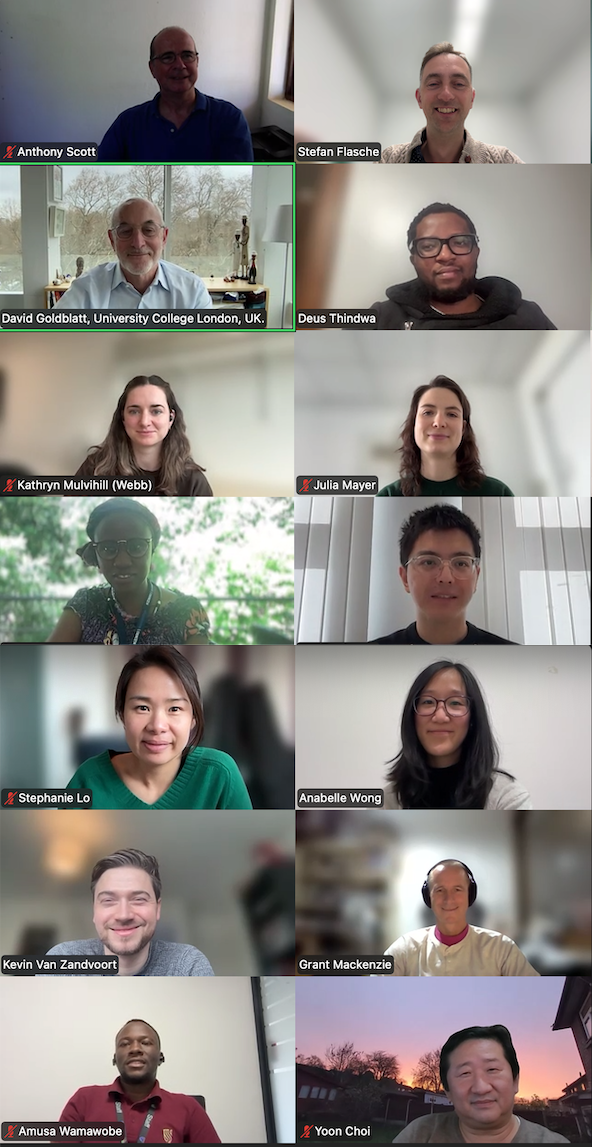
some of the March 2026 participants
Upcoming Meetings
Emmanuel Mendy: Pneumococcal conjugate vaccine booster dose coverage and the impact of an alternative two-dose schedule compared to the standard three-dose schedule in The Gambia, a modelling study
Lucy Ingaiza: RSV seroinfection patterns in German older adults
Past Meetings
Dexin Gong: Waning protection of long-acting RSV monoclonal antibodies in infants: a Bayesian analysis of clesrovimab and nirsevimab trial data
Yankho Thawani: Age-stratified serology defines the vaccination window to prevent RSV infection in Malawian infants.
Deus Thindwa: Mathematical modeling to assess the drivers of rebound in 19F invasive pneumococcal disease cases after replacing PCV7 with PCV13 in the United States
Katie Webb: Analysis of the global re-emergence of ST4
Kate Mellor: Maternal & environmental influences on pneumococcal colonisation
Matej Kritznar: Inferring transmission direction from carriage studies
John Ojal: PCV programme in Kenya
Julia Mayer: Nirsevimab benefit outside RSV season
Stefan Flasche: Protection from a single PCV dose in the first year of life
David Hodgson: Antibody kinetics & CoPs for RSV
David Hodgson: Antibody kinetics & CoPs for RSV
Kevin van Zandvoort: Early impact of a PCV campaign in a Somali refugee camp
Isaac Osei: Identifying specific age-group reservoirs for persistent vaccine-type pneumococcal carriage in rural Gambia
Grant McKenzie: Effectiveness of reduced dose schedules to control pneumococcal carriage and disease in the Gambia, a cRCT
Raymond: Understanding the invasiveness of pneumococcus using genomic data
Charles: Urine-based detection of pneumococcal serotype among hospitalised children with acute respiratory infections and high antibiotic exposure in Malawi
Akuzike Kalizang'Oma: Three dose PCV schedules; a cRCT in Malawi
Kaiyuan Sun: RSV transmission in South African households
Annabelle Wong: The association of post booster IgG response and vaccine efficacy against carriage in Israeli children
Ayaka Monoi: Benefit-risk analysis of maternal RSV vaccine in South Africa
Kate Gallagher: A global analysis of pneumococcal invasiveness
John Ojal: Impact of the current, and of potential policy options of, PCV programme in Nigeria
Stefan Flasche: What to do with PCV20 in the EU?
ISPPD practise: Dam, Momodou, David
Yoon Choi: Potential impact of new higher valency PCVs in England – a mathematical modelling study
Harry Hung: A Portable and Scalable Genomic Analysis Pipeline for Streptococcus pneumoniae Surveillance: GPS Pipeline
George Qian & Jane Metz: Pneumococcal density, the Live Attenuated Influenza Vaccine and Transmission of Streptococcus Pneumoniae in UK families (the TOP study)
Akuzike Kalizang'oma Intermediate results of a cRCT comparing 3p+0 and 2p+1 in Blantyre Malawi
Akuzike Kalizang'oma: Azithromycin resistance in pneumococci in Malawi following the MODOR trial
Greg Barnsley: Considerations for MDAs with Azithromycin in acute phase humanitarian crises
Kate Gallhager: The vaccine efficacy of fractional doses of PCV
Billy Quilty: An overview of the evidence on the ability of a reduced dose PCV schedules to control VT carriage
Rasheed:Effect of a PCV booster dose on the density of VT pneumococcal carriage
Jada Hackmann: “Evaluating Methods for Identifying and Quantifying Streptococcus Pneumoniae Subpopulations Using Next-Generation Sequencing”
Yicong L:Understanding the impact of pneumococcal conjugate vaccines on the spread of antibiotic resistance using phylogenetics
Nick C: NFDS models to predict the impact of switching to PCV15 or PCV20 in the UK
Stephanie Lo: Genomic serotyping for pneumococcal carriage – are we there yet?
Billy Quilty: Non-inferiority of reduced dose pneumococcal schedules in Nha Trang, Vietnam
Megan Verma: Streptococcus pneumoniae carriage in 75 countries from the RESPICAR dataset
ISPPD preparation: George Quian, Dam Khan, Modupeh Betts, Katherine Gallagher
Brenda: Widespread sharing of pneumococcal strains in a rural African setting: proximate villages are more likely to share similar strains that are carried at multiple timepoints
Aisha: Monitoring the post PCV disease burden in Nigeria through carriage surveys
Deus Thindwa:Immunogenicity of alternative ten-valent pneumococcal conjugate vaccine schedules in infants in Ho Chi Minh City, Vietnam: results from a single-blind, parallel-group, open-label, randomised, controlled trial
Stephanie Lo: Decoding pneumococcal genomes to inform future vaccine design
Tomoka Nakamura: Decline in pneumococcal disease in young children during the COVID-19 pandemic associated with suppression of seasonal respiratory viruses, despite persistent pneumococcal carriage: A prospective cohort study
Yang Liu: PCV uptake in the private market in China, a systematic review
Contact
If you wish to join the network please contact the PING secretariat
To get an impression of the structure of the meetings check out our slide deck history